
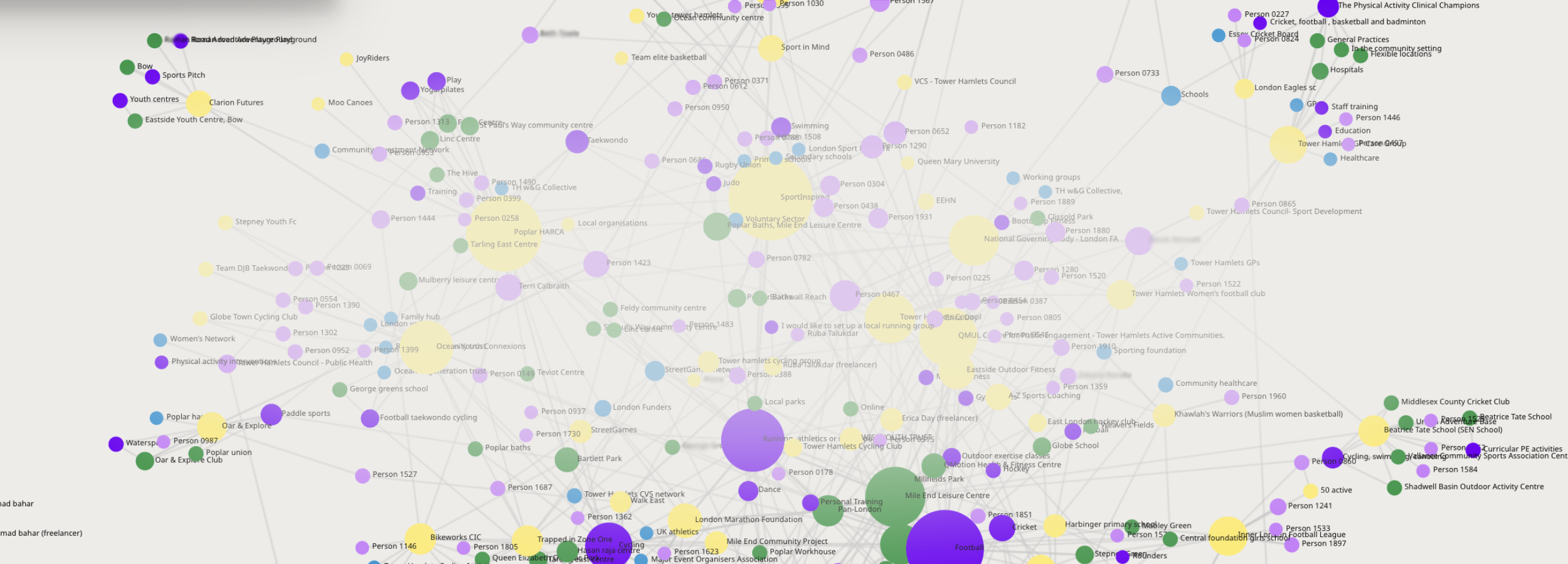
Collaboratively mapping a sector
Whether its a focus on Young People, Sport or the Arts, shared goals are often held by a broad mix of statutory services, organisations, the voluntary sector and residents.
People put in a huge amount of energy to move mixed communities of profession and practice like this forward, navigating finance, power and culture disparities as best they can.
With untapped collective knowledge, agency and leadership distributed through the network, people work in the only ways they know - further embedding bias, power imbalances and dysfunction.
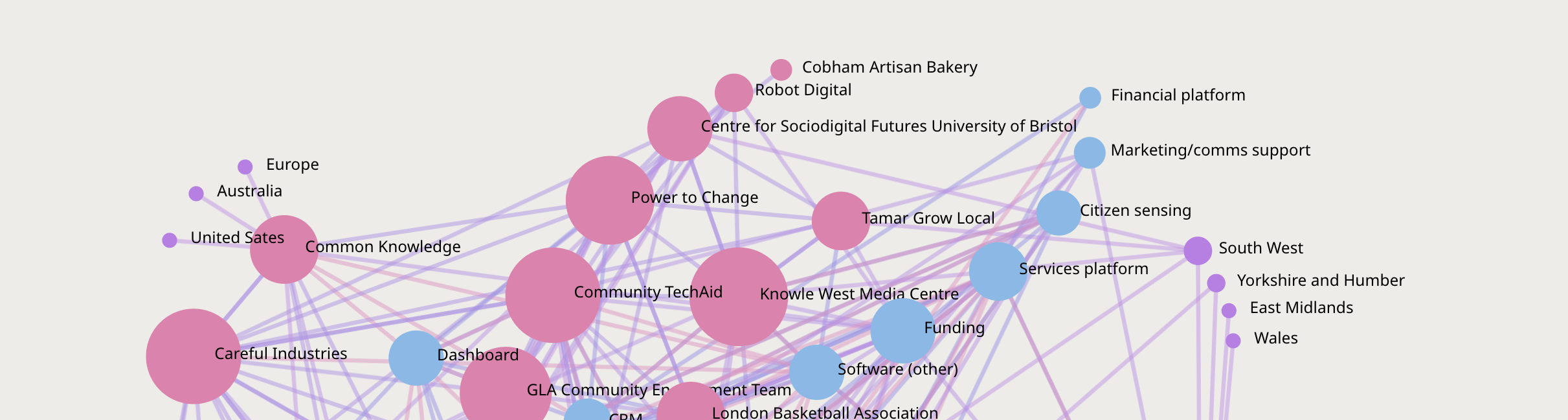
The Relational Mapping Toolkit makes all these patterns and complexities visible to everyone, enabling everyone to take action:
For the stakeholder community, the maps show:
Who is there and what everyone is working on
For a sector working on provision to the general public (such as Sport or the Arts), the maps show where collaborations could happen and where the gaps are.
For those strategically resourcing and building the community, the maps show:
A broader section of the network - and often more of the grassroots - because the community decides who should be included.
Who is holding a lot of relationships at the centre of the stakeholder network
Which organisations are delivering priority services or activities but are less well supported at the margins
Who bridges the essential work of key organisations.
How joined up or collaborative are the organisations delivering specific areas of provision or purpose.
Who has been a stable part of the community for a long time, but is under-resourced and overlooked.
“Often mapping exercises are separated from reality, but with this toolkit we are showing what's actually happening on the ground- because its built by the stakeholder community, it’s real.
We’re seeing how the financing of initiatives is disconnected from the actually effective community-led activity. By mapping the Stakeholders’ true offer to communities this work makes a really strong case for how initiatives and services should be commissioned - and gives us the evidence to say that without these invaluable and highly nuanced community connections, nothing meaningful would get done”.
- Paul Macey. Co-ordinator, Pillgwenlly Masterplan, Newport City Council

Everyone gets equal access to the data - so everyone benefits from the insights it enables.
Everyone can see where the potential points of collaboration are, or where they are overlapping.
Facilitate and enable your community to do what it wants to do- connect and grow.
Identify resource gaps, and track second order impacts of your resources over time.